An Asian Art Technique for Contacting the Infinite
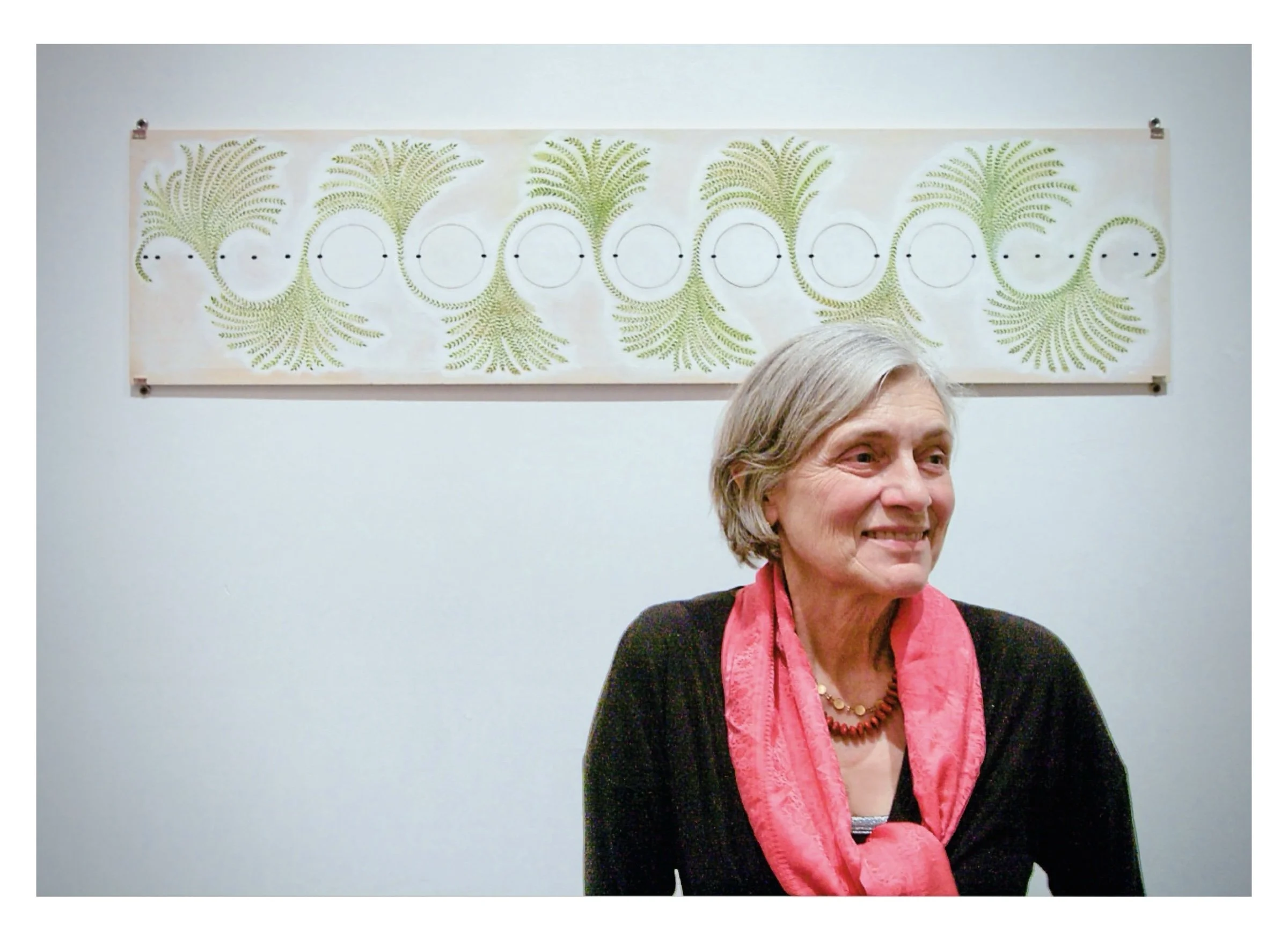
My desire is to bring a quality of perfection into my work that leads to infinite silence for myself and for the viewer.
In the mid 70’s I had the good fortune to begin a long friendship with the late Agnes Martin. We got on well because I sensed in her paintings and writings that same love of the universe and that same desire for perfection that I find in Indian art. I felt a silence when standing before her paintings. She knew that I had spent many years meditating morning and evening and during that time I experienced some silence. She always gave me encouragement to continue my search for perfection and to find a way to bring silence into my work. It took many years for me to begin to understand this.
From 1970 to 1995, I made a series of works inspired by my love of Asian patterns, particularly Indian fabrics and the patterns painted in miniature paintings. I began arranging layers of repeat images on various grounds. I realized these works with machine knitted wool, paint on patterned printed fabric, and multilayered paintings. My aspiration in all of this work was to express the infinite dimension of life.
While I was in India for an extended period from 1996-97, I began appropriating pattern elements from indigenous sources including vegetal/zoological motifs and symbolic/figurative images. My sources for these pattern elements included traditional miniatures, temple reliefs and fabric.
In 1996 I worked with Pahari miniaturist Vijay Sharma from Chamba, Himachal Pradesh, who inspired me to begin painting in miniature style with gouache paints and squirrel hair brushes on antique Indian paper. I later worked with leading Jaipur mimiaturist, Bannu Sharma who helped me to refine my use of the brush and realize symbolic forms. Bannu’s perfect focus and blissful devotion to the act of painting made his every mark like music or dance. Enraptured in the spontaneous play of his brushwork, he allowed images to flow directly from his heart through his hand and brush onto paper. He taught me exercises to refine my use of the brush while allowing awareness to pour from my innermost feelings into my work. I have practiced these exercises daily. I treat every mark as an opportunity to perfect both my articulation and the spontaneous flow of awareness from my heart into the emerging form.
My practice led to a series of small gouaches on antique Indian paper. These works incorporate appropriated ritual images and decorative motifs into abstract, all-over field compositions. Many of my recent paintings re-enact traditional South Asian designs called Kolams or Rangolis. These are complex symmetrical patterns that ladies skillfully draw on the ground outside their front door each morning before the sun rises with rice flour. Kolams are used in Tamil Nadu and other parts of India to ward off evil and entice Mother Divine and good fortune into homes. I love the way the lines in these images turn back on themselves endlessly. I love the junction points at which the lines cross over each other. I especially like trying to draw them perfectly while enabling a flow of the image from heart through hand through the tip of the brush out onto the paper. Though my kolams are borrowed from folk images in which I sense a quality of perfection, this perfection really enters my work through an experience of boundless silence that making brushstrokes enlivens in me. My aspiration is to flow this silence onto paper through arrangements of brushstrokes that evoke an experience of silence in others.
I am creating works that articulate indigenous subject matter (ritual images) with an unrelated indigenous technique (miniature painting). I appreciate and play upon my juxtaposition of appropriated folk images with appropriated classical technique as an end in itself. My paintings, however are in essence arrangements of tiny painterly gestures. I love making fine lines; shifting tones from dark to light; thinking of the paper as the ground of life, and letting forms, tonalities, and colors build up on the paper as if they were growing on a living field. I enjoy using white halos and dark shadows to reveal different layers of life blossoming on this field. I use these marks to construct images that resonate with the deepest levels of my sensibility, to bring a quality of perfection into my work that leads to infinite silence for myself and for the viewer, an ideal that I find at the essence of all Indian art.
Painting and drawing have become an addicting experience for me. Making my work draws me into a state of one-pointedness in which I am not thinking about anything else, an experience of silence and inner happiness, my version of an encounter with the infinite.
Charlotte Cain 2003